Monday, October 31, 2011

Forget Your Facebook Password? Your “Trusted Friends” Could Help


Facebook is releasing a new method for accessing your account when you lose your password: a little help from “trusted friends.”
The social network says it is testing a new tool in the coming weeks that will let you designate three to five friends you trust. If you forget your password or can’t access your email, Facebook will send your friends a code that they can pass along to you.
We’ve probably all been there: You forget your password and have to go through the “Forget your password?” process of waiting for a new one to arrive by email. Or, if we use Facebook’s comparison, you lock yourself out of your house — and now can go to a friend who has a spare key. Your spare key for Facebook is the code.
The new system doesn’t actually seem more efficient than the usual route if you’ve simply forgotten your password, but if for instance your account has been hacked and you’ve been locked out of your email, this is a new solution. It adds a new layer of security (the feature was announced for National Cybersecurity Awareness Month), too, since your friends can verify your identity more easily than any automated email.
Security firm Sophos points out, though, that a hacker could also remove or change your trusted friends settings and render the feature useless.
To set up “trusted friends,” go to your Security Settings Page (Account > Account Settings > Security), and click on the Trusted Friends section. From there, you can scroll through your friends and choose up to five. (You may not have access to this just yet — this section doesn’t appear in my settings.)

BlackBerry Offers a Free PlayBook, ( If You Buy Two First)


We’ve seen this deal from grocery stores and apparel retailers — but a buy two get one free tablet deal?
BlackBerry is now offering business customers a freePlayBook tablet computer with every two purchased, in a newmarketing plan running through Dec. 31. The company is likely trying to increase its share of the business user market with the deal, as few individuals purchase multiple tablets for personal use. But, dare we say, giving away a third tablet seems like the company’s gotten a bit desperate to spread the device.
Each purchase will also come with a premium accessory, such as a leather sleeve, charging pod or high-speed cable.
The 16 GB PlayBook starts at $499. The deal applies to the 16 GB, 32 GB and 64 GB models, although all three must be the same storage configuration.
What do you think of this deal? Does it reflect badly on the future on BlackBerry tablets or will it help spread the RIM device? Let us know in the comments.

Massive hack attack hit 760 companies

Massive hack hit 760 companies
RSA's SecurID tags were hardly the only victims to be brutalized by a massive cyberattack that occured earlier this year.

A massive cyberattack that led to avulnerability in RSA's SecurID tags earlier this year also victimized Google, Facebook, Microsoft and many other big-named companies, according to a new analysis released this week.
A list of 760 organizations that were attacked was presented to Congress recently and published by security analyst Brian Krebs on his blogMonday.
The list is the first glimpse into the pervasiveness of the attack that brought RSA to its knees. Those in the security industry have long suspected that RSA was not the hack's only victim, but no other companies have been willing to talk publicly about whether they had also been compromised.
The names mentioned on Krebs' list include about a fifth of the Fortune 100, as well as many other massive corporations.
Abbot Laboratories (ABTFortune 500), Charles Schwab (SCHW,Fortune 500), Freddie Mac, PriceWaterhouseCoopers and Wells Fargo (WFCFortune 500) are all named.
Tech giants like Amazon (AMZNFortune 500), IBM (IBMFortune 500), Intel (INTCFortune 500), Yahoo (YHOOFortune 500), Cisco (CSCOFortune 500), Google (GOOGFortune 500), Facebook, and Microsoft (MSFTFortune 500) are also included, as well as government agencies like the European Space Agency, the IRS, and the General Services Administration. Government security contractor Northrop Grumman (NOCFortune 500) was on the list, as was MIT.
The list of affected companies was obtained from a breached "command and control" server, the name for a machine that hackers use to direct the fleets of compromised PCs that they have gained control over. Krebs said he wasn't at liberty to reveal how that server was discovered or who analyzed the data.
The names came to light after researchers traced back the corporate networks that were communicating with the server that attacked RSA. The first victims started "phoning home" as early as November 2010, Krebs said.
But there's a big caveat: As Krebs was quick to note, many Internet service providers were on the list, most likely because their subscribers were attacked using their network, not because the companies themselves were compromised. That means that companies like Comcast (CMCSA,Fortune 500), Windstream (WIN), Verizon (VZFortune 500), AT&T (TFortune 500) and Sprint (SFortune 500) may be off the hook.

Really? AOL Eyes Merger With Yahoo


Reports have surfaced that AOL and Yahoo are once again discussing combining the two languishing Internet companies.


According to Bloomberg, AOL CEO Tim Armstrong is discussing the possibility with Yahoo advisers. This development follows the firing of Yahoo CEO Carol Bartzearlier this week.
However, CNBC has since reported that a “source close to Yahoo says no interest in a deal with AOL,” so this rumor may be nothing but wishful thinking on AOL’s part.
This isn’t the first time AOL and Yahoo have been linked. Yahoo was said to be considering a deal with AOLfollowing its rejection of Microsoft’s unsolicited buyout offer in 2008. Last year, rumors again surfaced, focusing on a combination that would see AOL split its content and dialup subscription business (yes, it still exists), and merging the former with Yahoo.

Monday, October 17, 2011

Apple publishes guide on how to set up iCloud


Apple has released a guide to show users how to set up iCloud on their iPhone, iPad, iPod touch, Mac or PC. The instruction set also details how to activate Find My iPhone, a feature that allows you to easily locate your handset should it become lost or stolen.
The first step is to update your iOS device to iOS 5 which requires the latest version of iTunes (currently 10.5) for your Mac or PC. Once you have installed iTunes and updated your firmware on your Apple device, you will be prompted with a series of basic questions to enable iCloud.
After the initial setup, the majority of adjustments can be made in the iCloud options menus by tapping Settings then iCloud. Inside the iCloud menu, you can enable or disable multiple services such as Contacts, Reminders, Bookmarks and Notes. As part of the service, each category that you enable will be backed up and synched across all of your other iOS 5 or iCloud-enabled devices.
iOS owners can also enable automatic downloads which will automatically sync any new music, apps and book purchases across all iCloud devices. To enable this feature, tap Settings and then select Store.
Furthermore you can enable Find My iPhone, a service designed to locate your handset on a map should it become lost or stolen. To use this service, simply install the Find My iPhone app on another iOS device and sign into it with your Apple ID. Once located, you can display a message, play a sound, remotely lock the device or erase all of your data.
Finally there is the ability to turn on iCloud Backup which will back up selected data to iCloud whenever your device is plugged in, locked and connected to Wi-Fi.
Mac users will need the latest version of OS X Lion (version 10.7.2 as of writing). Windows users must have either Vista Service Pack 2 or Windows 7 to use iCloud.

Thursday, October 13, 2011

GoDaddy.com' Elephant Killer -- PETA Is Extorting Me

The GoDaddy.com CEO who shot and killed an African elephant is now taking aim atPETA for blasting his hunting trip -- vowing he won't be extorted by the animal defenders.


Bob Parsons triggered controversy after posting an Internet video chronicling his elephant slaying during a trip to Zimbabwe.

TMZ obtained a copy of the letter PETA sent Parsons, presenting him with its "first-ever Scummiest CEO of the Year Award" -- and informing him PETA is "taking our domain-name business elsewhere."

Parsons tells TMZ, "I understand PETA has an agenda, but I refuse to go along with their extortion-style practice."

Parsons claims he was only hunting "problem elephants"  -- ones that destroy the villagers' crops ... adding, "I stand by my decision to help African villagers."  Parson claims he has the support of tribal leaders there.

In its letter, PETA points out there are effective and nonlethal methods already being used to keep elephants from village crops. But Parsons isn't giving in to PETA's request that he back more humane methods ... saying, "Will we donate to PETA in return for their business? Absolutely not."

Lost iPhone Saga


                              Gizmodo editor Jason Chen showed the prototype in a video


Gray Powell, the Apple computer engineer who lost the phone, forgot it while out celebrating his 27th birthday at a German beer garden called Haus Staudt.


The phone was disguised as an iPhone 3G version, but the people who obtained it worked out its true identity.
After Apple discovered that the handset had been sold to Gizmodo, it demanded that the device be returned.
The Cupertino-based electronics giant even contacted police who searched Mr Chen's home and confiscated three Apple laptops, a 32GB Apple iPad, a 16GB iPhone and a Samsung digital camera.
Gizmodo eventually did give the prototype back - but only after it published photos and a video of the device on its website.
The story became known as The Complete Lost iPhone Saga.
Former Gizmodo editorial director Brian Lam reflected on the incident in his blog.
"An hour after the story went live, the phone rang and the number was from Apple HQ," he wrote, adding that the call was from the former Apple CEO Steve Jobs, who died on 5 October 2011.
Mr Jobs asked to have his phone back.
"He wasn't demanding. He was asking. And he was charming and he was funny," wrote Mr Lam.
"I appreciate you had your fun with our phone and I'm not mad at you, I'm mad at the sales guy who lost it," continued Mr Lam, quoting Mr Jobs. "But we need the phone back because we can't let it fall into the wrong hands."


"Before he hung up, he asked me, 'What do you think of it?"
"I said, 'It's beautiful.

Lost iPhone 4 prototype sellers escape jail

iPhone 4 went public before Apple's official launch.


Two men who sold a lost iPhone 4 prototype to technology blog Gizmodo have been sentenced to one year of probation, avoiding jail time.
Brian John Hogan, 22, and Sage Robert Wallower, 28, were fined $250 (£159) - but allowed to keep the $4,750 (£3,014) they made from the sale.
They will also have to do 40 hours of public service.
An Apple engineer left the device at a bar in Redwood, California in March 2010, before it was unveiled.
Mr Hogan and Mr Wallower both pleaded no contest to a misdemeanour charge of theft of lost property.
Gizmodo journalists, including the editor Jason Chen, whose home was raided by police after the blog obtained the device for $5,000 (£3,173), escaped prosecution.
The judge considered that Mr Wallower had served in the armed forces and Mr Hogan was enrolled in San Jose State, and neither had any criminal record, and decided that jail time wasn't required.
"This was a couple of youthful people who should have known better."
Law Bite - A California law states that anyone who finds lost property and knows who the owner might be but "appropriates such property to his own use" is guilty of theft.

Wednesday, October 12, 2011

Samsung crashes iPhone 4S block party, lures Aussies with $2 Galaxy S IIs


Can't say we didn't see this catfight coming after Apple 
boldly rejected Samsung's settlement offer in Australia, but man, the latter certainly isn't afraid of striking back in its enemy's front yard. According toThe Sydney Morning Herald, Sammy's set up a pop-up store merely meters away from Apple's Sydney store, all for just stealing the thunder from the iPhone 4S launch this Friday. The campaign? 


For the first ten customers each day up to Friday, the Korean giant's offering its Galaxy S II for just $2 sans contract -- no wonder the line's already longer than Apple's, according to the Herald. But of course, Samsung's also effectively funding some of these folks for their iPhone 4S from next door, so it's pretty much a win-win situation for both companies. See? 


There's always a happy ending, and let's hope that the upcomingNexus Prime won't add fuel to the ongoing patent dispute.

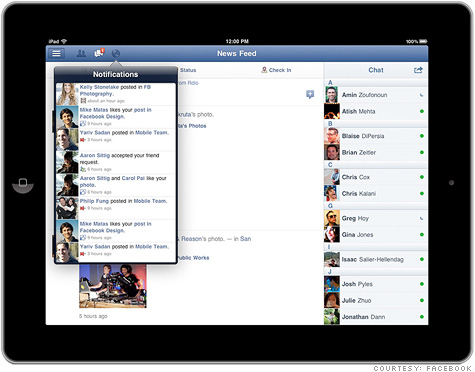
Finally! Facebook releases its iPad app


One year, six months, and seven days after the iPad first went on sale, Facebook has at last released its app for Apple's tablet.
"Many of you have been asking about Facebook for iPad," the company said in an understated blog post Monday. "Today, it's finally here."
The long-delayed app has the subject of much Silicon Valley chatter. Some rumors suggested that a rift between Facebook CEO Mark Zuckerberg and Apple's AAPL, Fortune 500) executive team over Apple's Ping social network was to blame for the delay. Others claimed that Facebook preferred a Web-based application that bypassed Apple's strict app store rules.
Former Facebook developer Jeff Verkoeyen, the lead engineer on the the iPad app, wrote on his blog recently that he quit the company after Facebook continually delayed the release of the iPad app. It had been in the works since October 2010 and was essentially completed in May, Verkoeyen said.
"For reasons I won't go into details on the app was repeatedly delayed throughout the summer," Verkoeyen wrote. "Needless to say this was a frustrating experience for me. The experience of working on this app was a large contribution to the reasons why I left Facebook, though that doesn't mean it wasn't a difficult decision."
If Verkoeyen's timeline is correct, that means that the Facebook iPad app was stuck in limbo longer than the Apple's notoriously delayed white iPhone 4.

Monday, October 10, 2011

Samsung wants iPhone 4S banned in Euro


Samsung is seeking an injunction to get the new iPhone 4S banned from sale in France and Italy.
It claims that Apple has used 3G wireless technology, which Samsung invented, without paying for it.
Samsung claims Apple failed to license patented technology in the iPhone 4S


A patent war between the companies has been rumbling on for months in courts around the world.
Apple has obtained temporary embargoes on its rivals' products in Australia and Germany and is seeking similar rulings in several other countries.
In a statement, Samsung said: "Apple has continued to flagrantly violate our intellectual property rights and free ride on our technology, and we will steadfastly protect our intellectual property."
Patent law blogger Florian Mueller warned that Samsung was putting the cart before the horse by seeking an injunction before negotiating terms.

Many observers believe that Samsung is walking a fine line between standing-up to Apple and avoiding jeopardising valuable contracts with its occasional foe.
  • The Galaxy Tab 10.1 is currently banned from sale in Germany.
  • A ban on sales of Samsung smartphones is due to come into effect in the Netherlands in October.
  • Samsung has postponed its tablet launch plans in Australia while its legal battle there is ongoing.
Joint-Family-Fact >> Samsung supplies parts for many of Apple's devices, including screens for some of its smartphones and tablets. The two companies are said to have agreed a components deal in February worth $7.8bn (£5bn)